Friday, 12 October 2012

Depth of field - Jan Groover


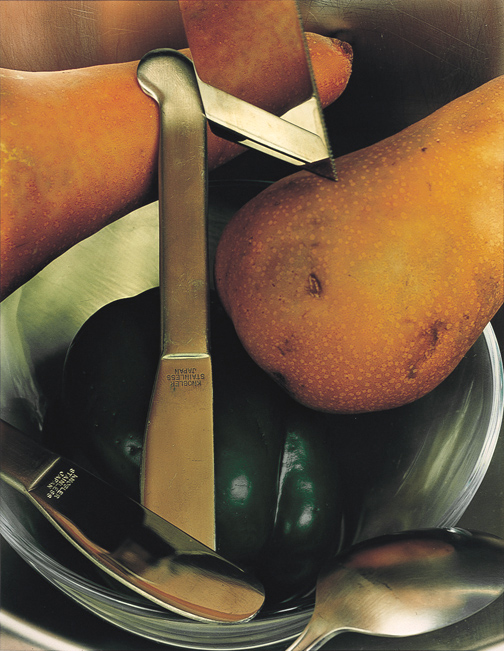
I am doing some research into Jan Groover and to see how she used depth of field in her still live work. Jan groover is an american photographer born in 1943 who is best known for her still life photographsof household utensils. She graduated Pratt institue with a bachelor fine arts in painting and went on to complete a masters degree at university. Jan went to work as a teacher at the University of Hartfordand it was at this time that she took an interest in photography instest of painting.
Jan started creating photographs in the 1970's, she took photo's that emphasized speed, distance and colours. In 1978 she started to take pictures of everyday household appliances out of your home she took photos of knifes, forks, whisks, spoons, houseplants and colourful food. Jan could change the lighting in this style of photography and she could make her subject shine almost, she could choose where any shadows went and what light give the image the mood she wanted. She would create an image by changing the combination of subjects to change the colours, shapes and textures until she was satisfied.

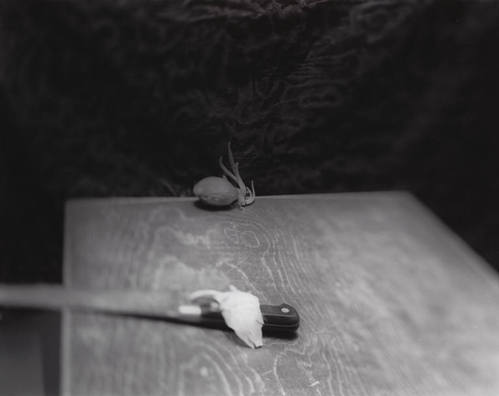


I think Jan Groovers images are very creative, i like the shapes she makes and the colours she brings together by the way she combines the subjects, she also uses reflections from stainless steel to brings patterns into the image. She makes everyday household objects look beautiful. I think she uses shallow depth of field in the images that i have shown so that you are concertrating on the subject and to make the shapes and colours bolder.


Depth of field Diane Arbus


I am doing some research into photographers who demonstrate depth of field so i can give my opinions on there work. The first photographer i am looking into is Diane Arbus, she was an american photographer born in 1924 in New York city to a wealthy jewish family. She had shown artistic talent from a young age creating drawings and paintings in high school. Diane married her childhood sweetheart when she was 18. Her husband, Allan Arbus was a photographer and they built up a successfull photography business together, working in advertising and fashion photography, they work for magazines such as Vogue and Harper’s Bazaar . In 1956 Diane wanted to create work on her own and quit her business, around the this time she went to study with Lisette Model.  Lisette encouraged Diane to find her own style and helped her identify the sort of subjects she wanted to photography and what she wanted to get out of her photographs.
Diane started to walk around the street of New York City visiting seedy hotel rooms, walking through public parks and even visiting a morgue looking for unusual people. Some would say she took portraiture photographs of freaks or people who were diffrent but whether she was taking photographs of "Freaks" or people of a normal appearence her photographs always had an abnormal, surreal feel to them. Diane would capture square portraits of transvestites, dwarfs, giants or people who's apperance's aren't what the world would call normal she would also take photographys of mentally disturbed people.  By the mid-1960's she had become a well-astablished photographer. She also taught photography for a while in the 60's.
Diane was well known for her ability to capture diffrent sides and emotions of people with disabilities from unusual backgrounds, she wanted wanted people to see them how they really were. Her photographs where mostly taken in black and white and
 Many of her portraits were taken in natural or existing light with much of the focus on her subjects’ facial expressions and unique mannerisms.


                                 Identical twins
                               Boy with a flag
 A Young Man in Curlers at Home on West 20th Street

A young Brooklyn family going for a sunday outing
              Girl with a cigar


 When i first started researching into Diane Arbus i thought her photographs where very morbid and depressing. But her portraites tell a story about the subject/s. I think the photos work well in black and white. I don't think i'd be able to have one of these photos hanging up in my home  but i do like the idea of the photographs she took. She got to know her subjects and studied them. There are diffrent thoughts on her work, some people would say it is cruel to take photographs of less fortunate people but other people thought she made people who were "freaks" normal, she respected her subjects for who they were. The photographs that i have put on here, i think, show short depth of field these are all portraiture photographs and Diane would have used a lardge aperture so that her subject was in focus and the background was blurry.


Thursday, 11 October 2012

Assighnment 2: Shutter speed (abstract images)

Shutter speed controls the amount of time the shutter is open, which lets light through to the sensor/film and you can control exposure using it. Shutter speed is measued in fractions of a second. I am going to be using slow shutter speeds to create abstract images.  I think abstract photography is about contrast of colours, textures and shapes. You can use your imagination in a diffrent way with abstract images because alot of the time there is no subject to focus on. These are my first attempts at creating abstract images using shutter speeds. I used a Cannon EOS 550D with the TV setting on my camara and i have used diffrent camara movements to create diffrent affects and i have used diffrent light settings when taking the images..

 Sunset: 1/8 - i moved the camara from left to right whilst taking this picture.
.
 Stranger: 1/15 - i think this image is dark and mystrous and i think the mix of colour works well.
 Rush: 1/15 - you can tell what direstion i moved the camara in by looking at this image

 Whirled wind: 1/13 - i took the image looking up facing the trees and i have spun around whilst taking the shot. I like the way the light looks like a whirled wind. 
 
                          Soft: 1/8 : I think that the colours and textures in this image are pastel like

           Jazz man: 0"3 - This is an oil painting my dad has painted and i have taken the image whilst moving the camara in a circula movment.


                         Guitar: 0"3


Tuesday, 9 October 2012

Assighnment 1: Depth of field

The definition of Depth of Field (DOF) is the distance in front of and beyond the subject that appears to be in focus. The in-focus or sharp part of the photograph is the Depth of Field. Having a larger depth of field means more is in focus while having a smaller depth of field means less is in focus. The depth of field is controlled using your lens, focus, and aperture. Aperture is the hole in the lens that lets light through to the sensor/film.  For short depth of field images i will be using a wide aperture which is a small f-stop (ie. F2.8 - F3.5 - F4). Because it was my first attemps at taking short DOF photographs I thought i would just take images of anything and everything but as you start to use your imagination a bit you can see great photos everywhere you go. I can't wait to see the changes in the way I think about and the way I take photographs as I learn more and more about it.

To take these images i have used a Canon EOS 550D with the AV setting.


          Duck Pond: F3.5
 

              Tree: F4 

          Berries: F4.5

              Pebbles: F3.5

              Cobbles: F4

            Fallen leaf: F3.5
 
             Fence: F3.5
  
         Have you got a wicked side: F3.5
 
         Whiskey: F3.5
 
         Earphones: F4.5
 
        Keyboard: F4
 
      Apples: F4.5